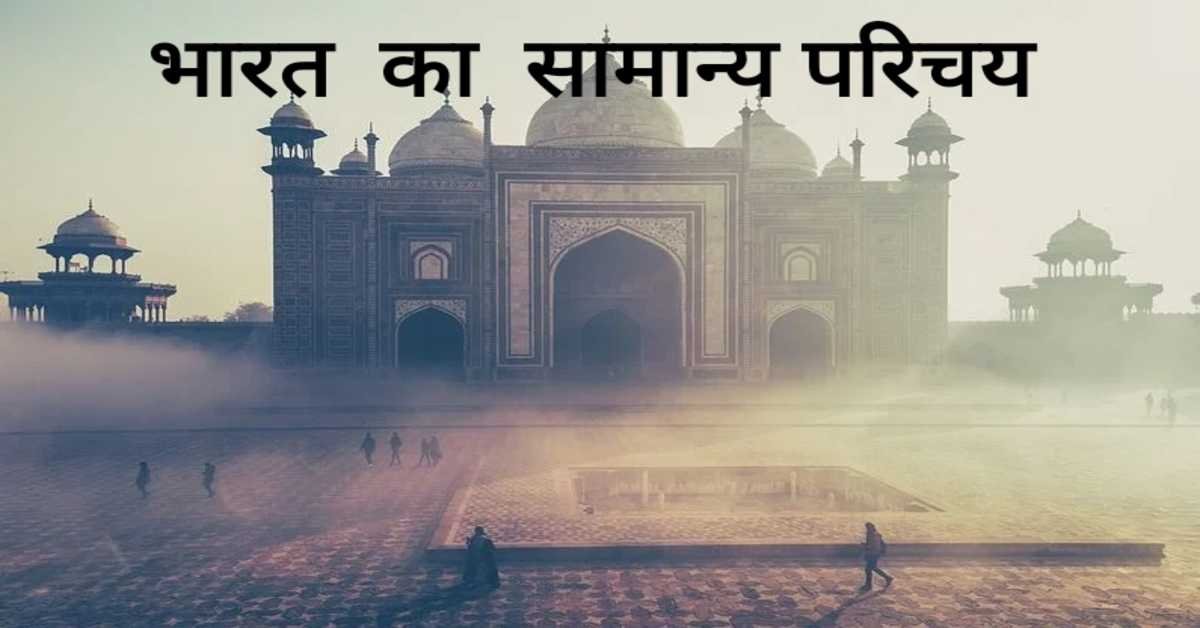
सामान्य परिचय– हमारे देश का नाम भारत है। पुराने समय से अब तक भारत को बहुत नामों से जाना जाता है। पुराने समय में भारत के विशाल उपमहाद्वीप को 'भारतवर्ष' के नाम से जाना जाता था। भारत का नामकरण ऋग्वैदिक काल के प्रमुख जन 'भरत' के नाम से किया गया। भारत जम्मू दीप का दक्षिण भाग था। आर्यों का निवास स्थल होने के कारण इसका नामकरण आर्यावर्त के रूप में हुआ। वायु पुराण के एक अन्य संदर्भ में दुष्यंत और शकुंतला के पुत्र 'भरत' का उल्लेख मिलता है। जिसके नाम पर इसका नाम भारत पड़ा। वास्तव में भारत शब्द सबसे पहले उल्लेख पुराणों से ही मिला है। भारत के पर्याय के रूप में प्रयुक्त 'इंडिया' शब्द की व्युत्पत्ति की शुरुआत यूनानी शब्द 'इण्डोई से मानी जाती है। मध्यकालीन इतिहास लेखको (फारसी और अरबी) ने इस देश को 'हिंदू' और 'हिंदुस्तान' से संबोधित किया। भारत के उत्तर- पश्चिम, उत्तर तथा उत्तर-पूर्वी सीमा पर नवीनतम मोड़दार पर्वतों का विस्तार पाया जाता है, जबकि दक्षिण के प्रायद्वीपीय क्षेत्र का विस्तार पाया जाता है। भारत का प्रायद्वीपीय भू-भाग उत्तर में अधिक चौड़ा तथा 22° उत्तरी अक्षांश से दक्षिण की ओर संकरा होता गया। भारत का दोनों आक्षांशीय व देशांतरीय विस्तार लगभग 30 डिग्री है। भारत की मुख्य भूमि उत्तर में लद्दाख संघ राज्य क्षेत्र (पूर्व में जम्मू कश्मीर) से लेकर दक्षिण में कन्याकुमारी तक और पूर्वी में अरुणाचल प्रदेश से लेकर पश्चिम से गुजरात तक फैली हुई है।
General Introduction– The name of our country is India. India has been known by many names since time immemorial. In ancient times, the vast subcontinent of India was known as 'Bharatvarsha'. India was named after 'Bharat', a prominent man of the Rigvedic period. India was the southern part of Jammu Deep. Being the abode of Aryans, it was named as Aryavarta. Another reference in the Vayu Purana mentions Bharata, the son of Dushyanta and Shakuntala. After which India got its name. In fact, the first mention of the word Bharat comes from the Puranas. The origin of the word 'India' used as a synonym for India is considered to be from the Greek word 'Indoi'. Medieval historians (Persian and Arabic) addressed this country by 'Hindu' and 'Hindustan'. The extension of the latest fold mountains is found on the north-west, north and north-east border of India, while the expansion of the peninsular region is found in the south. The peninsular landmass of India became wider in the north and narrower in the south from 22° north latitude. Both the latitudinal and longitudinal extent of India is about 30 degrees. The mainland of India extends from the Union Territory of Ladakh (Jammu and Kashmir in the east) in the north to Kanyakumari in the south and from Arunachal Pradesh in the east to Gujarat in the west.
आकर एवं भौगोलिक अवस्थिति–
1. भारत की प्रमुख भूमि से दूर अंडमान तथा निकोबार द्वीप समूह में स्थित दक्षिणतम बिंदु 'इंदिरा पाॅइंट' अथवा पिगमालियन पाॅइंड (ग्रेट निकोबार द्वीप) तथा भारत का सबसे उत्तरी बिंदु 'इंदिरा काल' (लदाख) है। भारत का सबसे पूर्वी बिंदु 'किबीथु' (अरुणाचल प्रदेश) तथा पश्चिमी बिंदु 'गुहार मोती' (कक्षा जिला गुजरात) है। भारतीय भूमि का सबसे दक्षिणतम बिंदु 'केप कोमोरिन' (कन्याकुमारी, तमिलनाडु) है।
2. हिमाचल पर्वतमाला द्वारा भारतीय प्रायद्वीप की मुख्य भूमि को एशिया से अलग किया जाता है। भारत, पूर्व में बंगाल की खाड़ी, पश्चिम से अरब सागर और दक्षिण से हिंद महासागर से घिरा हुआ है।
3. भारत की स्थलीय सीमा की लंबाई 15106.7 किलोमीटर (और स्त्रोत में 15200 किलोमीटर) है।
4. मुख्य भूमि, अंडमान-निकोबार द्वीप समूह तथा लक्ष्य दीप समूह सहित भारत के तट रेखा की कुल लंबाई लगभग 7,517 किलोमीटर (7,516.6 किलोमीटर) है।
5. भारत का कुल क्षेत्रफल लगभग 32,87,263 वर्ग किलोमीटर है जो विश्व के कुल भौगोलिक क्षेत्रफल का 2.4% है।
Size and Geographic Location–
1. The southernmost point is 'Indira Point' or Pygmalion Pond (Great Nicobar Island) located in the Andaman and Nicobar Islands, away from the main land of India and the northernmost point of India is 'Indira period' (Ladakh). The easternmost point of India is 'Kibithu' (Arunachal Pradesh) and the westernmost point is 'Guhar Moti' (Class District Gujarat). The southernmost point of the Indian land is 'Cape Comorin' (Kanyakumari, Tamil Nadu).
2. The mainland of the Indian peninsula is separated from Asia by the Himachal ranges. India is surrounded by the Bay of Bengal in the east, the Arabian Sea from the west and the Indian Ocean from the south.
3. The length of the terrestrial boundary of India is 15106.7 kms (and 15200 kms at source).
4. The total length of India's coastline including mainland, Andaman-Nicobar Islands and Lakshya Deep Group is approximately 7,517 km (7,516.6 km).
5. The total area of India is about 32,87,263 square kilometers which is 2.4% of the total geographical area of the world.
6. भारत की आकृति लगभग चतुष्कोणीय है। इसका उत्तर-दक्षिण तक अधिकतम विस्तार 3,214 किलोमीटर तक पूर्व-पश्चिम तक अधिकतम विस्तार 2,933 किलोमीटर है।
7. भारत पूरी तरह से उत्तर-पूर्वी गोलार्ध्द में स्थित है। यह 8°4' उत्तरी अक्षांश से 37°6' उत्तरी अक्षांश के बीच तथा 68°7 पूर्वी देशांतर से 97°25' पूर्वी देशांतर तक विस्तृत है। कर्क रेखा (23°30') उत्तर अक्षांश) देश को लगभग बराबर भागों में (उत्तर- दक्षिण) में विभक्त करती है।
8. भारत में कुल 28 राज्य तथा 8केंद्र शासित प्रदेश हैं, जिन्हें मुख्य रूप में 6अंचलों में बाँटा गया है–
9. उत्तरी क्षेत्र– दिल्ली, राजस्थान, हरियाणा, चंडीगढ़, हिमाचल प्रदेश, पंजाब, लद्दाख, जम्मू कश्मीर।
10. पूर्वी क्षेत्र– पश्चिम बंगाल, उड़ीसा, झारखंड, बिहार।
6. The shape of India is almost quadrangular. Its maximum extension from north-south is 3,214 km, maximum extension from east-west is 2,933 km.
7. India lies entirely in the North-Eastern Hemisphere. It extends between 8°4' North latitude to 37°6' North latitude and 68°7' East longitude to 97°25' East longitude. Tropic of Cancer (23°30') north latitude) divides the country into almost equal parts (North-South).
8. There are total 28 states and 8 union territories in India, which are mainly divided into 6 zones-
9. Northern Zone – Delhi, Rajasthan, Haryana, Chandigarh, Himachal Pradesh, Punjab, Ladakh, Jammu and Kashmir.
10. Eastern Region – West Bengal, Orissa, Jharkhand, Bihar.
11. पश्चिमी क्षेत्र– महाराष्ट्र, गुजरात, गोवा, दादरा और नगर हवेली, दमन और दीव।
12. मध्यवर्ती क्षेत्र– छत्तीसगढ़, उत्तर प्रदेश, उत्तराखंड, मध्य प्रदेश।
13. दक्षिणी क्षेत्र– केरल, तमिलनाडु, कर्नाटक, आंध्र प्रदेश, तेलंगाना, पचेरी, अंडमान निकोबार लक्षद्वीप।
14. पूर्वोत्तर क्षेत्र– असम, मेघालय, सिक्किम, त्रिपुरा, मिजोरम, नागालैंड, मणिपुर, अरुणाचल प्रदेश।
15. देश की सबसे पूर्वी व सबसे पश्चिमी देशांतर रेखाओं के मध्य लगभग 30° का अंतर होने के कारण सुदूर पूर्वी व सुदूर पश्चिमी भागों के समय में लगभग 2 घंटे का अंतराल होता है।
16. मानक समय रेखा एवं कर्क रेखा आपस में एक-दूसरे को छत्तीसगढ़ में काटती है।
17. कर्क रेखा (23°30 उत्तरी अक्षांश) देश में कुल 8 राज्यो– मध्यप्रदेश, राजस्थान, गुजरात, छत्तीसगढ़, पश्चिम बंगाल, त्रिपुरा, झारखंड एवं मिजोरम से होकर गुजरती है।
18. भारत के पूर्वी और पश्चिमी घाट 'नीलगिरी' के आकार में मिलते हैं।
19. भारत एकमात्र ऐसा देश है, जिसके नाम पर किसी 'महासागर' (हिंद महासागर) का नामकरण) किया गया है।
20. क्षेत्रफल की दृष्टि से सबसे बड़ा केंद्र शासित प्रदेश लद्दाख और छोटा लक्ष्यदीप है।
11. Western Region – Maharashtra, Gujarat, Goa, Dadra and Nagar Haveli, Daman and Diu.
12. Intermediate Zone – Chhattisgarh, Uttar Pradesh, Uttarakhand, Madhya Pradesh.
13. Southern Region – Kerala, Tamil Nadu, Karnataka, Andhra Pradesh, Telangana, Pacheri, Andaman and Nicobar Lakshadweep.
14. North Eastern Region – Assam, Meghalaya, Sikkim, Tripura, Mizoram, Nagaland, Manipur, Arunachal Pradesh.
15. Due to the difference of about 30° between the easternmost and westernmost longitude lines of the country, there is a gap of about 2 hours in the time of the far eastern and far western parts.
16. The standard time line and the Tropic of Cancer intersect each other in Chhattisgarh.
17. Tropic of Cancer (23°30 North latitude) passes through total 8 states in the country- Madhya Pradesh, Rajasthan, Gujarat, Chhattisgarh, West Bengal, Tripura, Jharkhand and Mizoram.
18. Eastern and Western Ghats of India meet in the shape of 'Nilgiri'.
19. India is the only country after which an 'ocean' (Indian Ocean) has been named.
20. The largest union territory in terms of area is Ladakh and the smallest is Lakshadweep.
21. क्षेत्रफल की दृष्टि से भारत का सबसे बड़ा राज्य राजस्थान और सबसे छोटा राज्य गोवा है।
22. जनसंख्या की दृष्टि में सबसे बड़ा केंद्र शासित प्रदेश दिल्ली तथा सबसे छोटा लक्ष्यदीप है।
23. जनसंख्या की दृष्टि से भारत का सबसे बड़ा राज्य उत्तर प्रदेश और सबसे छोटा राज्य सिक्किम है।
24. दमन एवं दीव के बीच खंभात की खाड़ी उपस्थित है।
25. भारत के राज्यों एवं केंद्र शासित प्रदेशों में उत्तर प्रदेश एक ऐसा राज्य है, जिसकी सीमा सर्वाधिक राज्यों से जुड़ी हुई है। उत्तर प्रदेश की सीमा कुल 8 राज्यों एवं केंद्र शासित प्रदेश (दिल्ली) से जुड़ी हुई है, जिसमें सर्वाधिक सीमा 'मध्य प्रदेश' से एवं सबसे कम सीमा 'हिमाचल प्रदेश' से संलग्न है।
26. राज्य तथा केंद्र-शासित प्रदेश में पांडुचेरी एक ऐसा केंद्रशासित प्रदेश है जो 3 राज्यों में फैला हुआ है। जिसके अंतर्गत 'यनम' (आंध्र प्रदेश) 'कराईकल' (तमिलनाडु) 'माहे' (केरल) तथा 'मूल पुदुचेरी' को सम्मिलित किया जाता है।
27. भारत पूरी तरह से उत्तर पूर्वी गोलार्ध में स्थित है। यह 8°4 उत्तरी अक्षांश से 37°6 उत्तरी अक्षांश के बीच 68°7 पूर्वी देशांतर से 97°25 पूर्वी देशांतर तक विस्तृत है। कर्क रेखा 23°30 उत्तरी देश को लगभग दो बराबर भागों में विभक्त करती है उत्तर- दक्षिण यह दो भाग में विभक्त करती है।
28. भारत में 9 राज्य तथा 4 केंद्र शासित प्रदेशों की सीमाएँ समुद्री तटरेखा से लगी है, जिसमें गुजरात की समुद्री तटरेखा सबसे लंबी तथा सबसे छोटी समुद्री तटरेखा वाला राज्य गोवा है। 19 राज्य एवं 4 केंद्र शासित प्रदेश हैं।
21. The largest state of India in terms of area is Rajasthan and the smallest state is Goa.
22. The largest union territory in terms of population is Delhi and the smallest is Lakshadweep.
23. The largest state of India in terms of population is Uttar Pradesh and the smallest state is Sikkim.
24. The Gulf of Khambhat is present between Daman and Diu.
25. Among the states and union territories of India, Uttar Pradesh is such a state, whose border is connected with most of the states. The border of Uttar Pradesh is connected to a total of 8 states and union territory (Delhi), in which the maximum border is attached to 'Madhya Pradesh' and the lowest border is attached to 'Himachal Pradesh'.
26. States and Union Territories Pondicherry is one such union territory which is spread over 3 states. Under which 'Yanam' (Andhra Pradesh), 'Karaikal' (Tamil Nadu), 'Mahe' (Kerala) and 'Original Puducherry' are included.
27. India is completely located in the North Eastern Hemisphere. It extends from 8°4 North latitude to 37°6 North latitude, from 68°7 East longitude to 97°25 East longitude. Tropic of Cancer 23°30 divides the northern country into almost two equal parts, north-south it divides into two parts.
28. In India, 9 states and 4 union territories are bordered by sea coastline, in which Gujarat has the longest coastline and Goa is the state with the shortest coastline. There are 19 states and 4 union territories.
इनमें से पांच राज्य–
1. हरियाणा
2. छत्तीसगढ़
3. तेलंगाना
4. मध्य प्रदेश
5. झारखंड
2 केंद्र शासित प्रदेश–
1.दिल्ली
2. चंडीगढ़
five of these states–
1. Haryana
2. Chhattisgarh
3. Telangana
4. Madhya Pradesh
5. Jharkhand
2 Union Territories–
1.Delhi
2. Chandigarh
जिसकी सीमा अंतर्राष्ट्रीय सीमा को स्पर्श करती है।
विश्व के देशों ने आपसी समक्ष के तहत मानक याम्योत्तर को 7°30' देशांतर के गुणांक पर चुना है, यही कारण है कि 82°30 पूर्वी याम्योत्तर को भारत का मानक याम्योत्तर चुना गया है।
यू.एस.ए. में 9 समय कटिबंध है, जबकि रूस में 11 समय प्रतिबंध है।
उत्तर प्रदेश का सोनभद्र देश का एकमात्र ऐसा जिला है जो चार राज्यों की सीमा को स्पर्श करता है।
उत्तर प्रदेश का सोनभद्र को स्पष्ट करने वाले चार राज्यों के नाम निम्नलिखित है।
1. छत्तीसगढ़
2. मध्य प्रदेश
3. बिहार
4. झारखंड
उत्तर प्रदेश से संलग्न राज्य केंद्र शासित प्रदेश–
1.हिमाचल प्रदेश
2. उत्तराखंड
3. हरियाणा
4. राजस्थान
5. मध्य प्रदेश
6. झारखंड
7. छत्तीसगढ़
8. बिहार
9. दिल्ली।
Whose border touches the international border.
The countries of the world have chosen the standard meridian on the coefficient of 7°30' longitude under mutual consideration, that is why 82°30 east meridian has been chosen as the standard meridian of India.
USA has 9 time zones, while Russia has 11 time zones.
Sonbhadra of Uttar Pradesh is the only district in the country which touches the border of four states.
The following are the names of the four states that define Sonbhadra of Uttar Pradesh.
1. Chhattisgarh
2. Madhya Pradesh
3. Bihar
4. Jharkhand
State Union Territory adjoining Uttar Pradesh–
1.Himachal Pradesh
2. Uttarakhand
3. Haryana
4. Rajasthan
5. Madhya Pradesh
6. Jharkhand
7. Chhattisgarh
8. Bihar
9. Delhi.
इन 👇 प्रकरणों के बारे में भी पढ़ें।
1. covid-19 महामारी से संबंधित महत्वपूर्ण तथ्य
2. भारत के प्रमुख पर्यटन स्थलों की सूची
3. विश्व के प्रमुख संगठन और उनके मुख्यालय
आशा है, उपरोक्त जानकारी परीक्षार्थियों के लिए ज्ञानवर्धक एवं परीक्षापयोगी होगी।
धन्यवाद।
B B Patle
edubirbal.com
टिप्पणियाँ (0)
अपनी टिप्पणी दें
इस लेख पर अभी तक कोई टिप्पणी नहीं है। सबसे पहले टिप्पणी करके चर्चा शुरू करें!